

School and District Plan Development

Overview

Planning is essential to school and district success. Schools and districts should regularly reflect on whether their systems and structures are effectively delivering the district’s vision for high-quality teaching and learning and identify implementation priorities to ensure practices are consistent and coherent. To support this reflection, NYSED has developed a School Needs Assessment and a District Needs Assessment to help identify priorities for the upcoming school year.

School-level Needs Assessment

The school-level Needs Assessment is led by a team from the school. The guidance document “Assembling Your School Improvement Planning Team” outlines considerations for schools, along with requirements for schools participating in the CSI, ATSI, and TSI Support Models. 

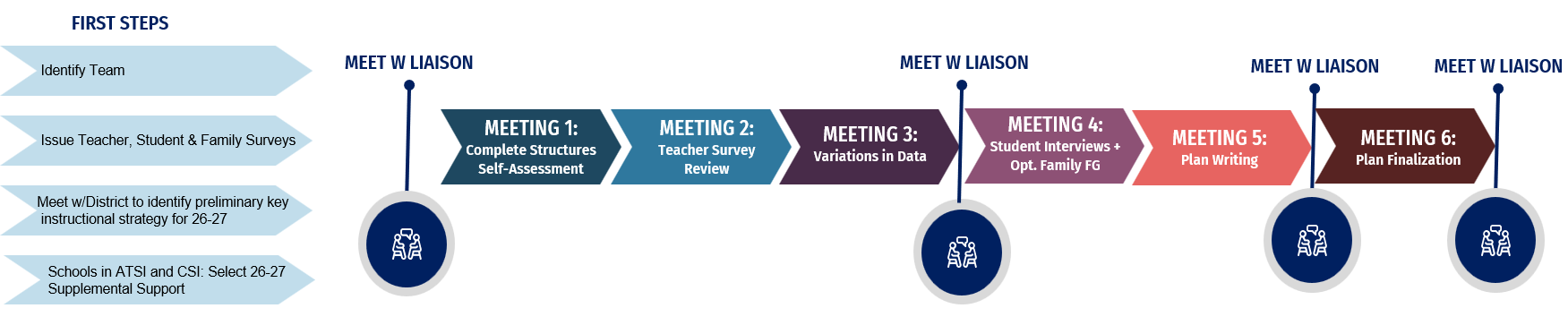
The School Needs Assessment process outlined by NYSED anticipates that the school team will engage in six meetings, and potentially more if necessary:

The School Needs Assessment sequence is outlined visually here.

More information can be found in the resources below.

District-level Needs Assessment

The district-level Needs Assessment is led by a team comprised of district and school leaders. The guidance document “Assembling Your District Improvement Planning Team” outlines requirements for Target Districts.

The District Needs Assessment and District Comprehensive Improvement Plan (DCIP) development process outlined by NYSED anticipates that the district team will engage in four meetings, potentially more if necessary:

  • Meeting 1: (Central Office DCIP members only) District Consistency and Coherence Self-Assessment
  • Meeting 2: (Full team) District Survey Review and Shared Vision for Teaching and Learning
  • Meeting 3: District Equity Report
  • Meeting 4: District Comprehensive Improvement Plan (DCIP) Writing

The District’s role in the Needs Assessment process is outlined visually here.

More information can be found in the resources below.

School Comprehensive Education Plan (SCEP)

The School Comprehensive Education Plan (SCEP) is the tool developed by the Department to support schools in planning ways to strengthen and establish systems and structures in the upcoming year.  Any school that is supported through the CSI, ATSI, or TSI support model will be required to develop an SCEP for the upcoming school year based on the School Needs Assessment conducted each Spring. 

District Comprehensive Improvement Plan (DCIP)

The District Comprehensive Improvement Plan (DCIP) is the tool developed by the Department to support districts in planning and organizing the district-level actions they will undertake to further strengthen and establish systems and structures in their schools identified for additional support.  All Target Districts are required to develop a DCIP for the upcoming year based on the District Needs Assessment conducted each Spring.

Before Your First Team Meeting

Schools: Prior to the first school team meeting, the school leader and district leader should work together to ensure the following steps are completed:

  1. Identify team
  2. Issue Teacher Survey, Student Survey and Family Survey
  3. Connect with District to identify preliminary instructional key strategy for 2026-27
  4. Schools in CSI and ATSI: Identify the 2026-27 Supplemental Support

Districts: Prior to the first team meeting, district leaders should work ensure the following steps are completed:

  1. Identify team
  2. Issue District Survey
  3. Connect with schools to identify preliminary instructional key strategies for 2026-27
Assembling Your Team

An essential component of improvement planning is creating an inclusive space that allows members of the school and district community to openly share their perspectives and work together to determine ways to promote their shared values.

The guidance document “Assembling Your School Improvement Planning Team” outlines considerations for schools, along with requirements for schools participating in the CSI, ATSI, and TSI Support Models.   

The guidance document “Assembling Your District Improvement Planning Team” outlines requirements for Target Districts.

Liaison Support

All schools in the CSI support model will be supported by a liaison from the New York State Education Department, while all schools in the ATSI and TSI support models will be supported by a liaison from the district and/or BOCES.

Liaisons will have a minimum of four touchpoints during the school plan development process:

  • Before the first team meeting
  • After the team has completed Meeting 3: Variations in Data
  • After the team has begun drafting their plan (Meeting 5)
  • After the team has finalized their plan to ensure that the plan meets NYSED’s SCEP Minimum Expectations. Liaisons should accommodate additional support requests as schedules permit.  

The District Liaison Guidance provides additional information regarding how to organize these check-ins.
District-Liaison Guidance

Writing Your School Plan

After the school has completed the steps above, the school team will write a plan to support continuous improvement in the school’s Tier 1 Core Instructional program through the use of:

  • 1-2 core instructional priorities, known as Key Strategies/Instructional Priorities
  • Core instructional structures that ensure that effective practices and standards-aligned instruction are consistent across the school, clear to new staff, and sustained even as leadership or initiatives change.

All plans must have:

  • The district’s vision for high-quality instruction
  • 1-2 key strategies that serve as broad instructional priorities
  • Core Structures in the following areas: Teacher Learning, Rigorous, Standards-Aligned Instruction, Every Student Thrives, and Attendance.
Key Strategies/Instructional Priorities

Schools should collaborate with their district to identify 1-2 Key Strategies/Instructional Priorities that will strengthen the instructional core and be the focus of teacher learning for the upcoming year.

Key Strategies/Instructional Priorities should be:

  • Instructional, not programmatic.
  • Broad enough to apply across grades/content but focused enough to drive teacher learning.
  • Concepts that can be explored with the Structures for Teacher Learning
  • Connect to Tier 1/Universal instruction
  • Stable enough to allow for deep learning and improvement over time, yet flexible enough to respond to emerging evidence about student needs.
  • Grounded in the instructional core, not buzzwords, fads, or short-lived initiatives. 


Examples of Key Strategies/Instructional Priorities

The SCEP template provides multiple pre-filled examples of Key Strategies/Instructional Priorities in a drop-down menu. Schools and Districts may also identify their own.

High-Leverage Instructional Core (Recommended Starting Points)

These priorities address the most common breakdowns in rigorous instruction and offer the strongest return on investment for teacher teams, professional learning, and coaching.

  • Engage students in cognitively demanding tasks that require reasoning, sense-making, and problem-solving.
  • Maintain cognitive demand by avoiding over-scaffolding, leading questions, or telling students what to think.

Additional Core Instructional Priorities

  • Increase opportunities for students to explain their thinking and build on the ideas of their peers through structured academic discourse.
  • Design intentional questions and prompts that press for reasoning and support sense-making rather than recall or guesswork.
  • Incorporate quick formative checks during instruction to understand student thinking in real time and adjust instruction responsively.

Mathematics

  • Deepen conceptual understanding alongside procedural fluency.
  • Strengthen use of multiple representations (models, diagrams, symbolic notation).
  • Increase opportunities for reasoning and problem-solving with grade-level tasks.
  • Build productive struggle so all students engage in challenging thinking.

Literacy

  • Strengthen comprehension and analysis of complex texts.
  • Increase academic vocabulary and language use across content areas.
  • Ensure regular evidence-based writing to support claims and ideas.
  • Support foundational skills in early grades.

Equity and Access

  • Ensure equitable access to grade-level content, especially for multilingual learners and students with disabilities, by coordinating with colleagues and aligning instruction to shared learning goals.


Core Structures

School teams are asked to identify core structures to support four areas: teacher learning, schoolwide consistency in instruction, student experience, and attendance. These structures include the routines used by grade-level teams and building-level teams. Schools will select the structures to build or refine so the school functions as a coherent system focused on rigorous, equitable learning. Selected structures should be observable, actionable, and embedded in daily practice, with clear plans for how they will be enacted and supported over time.

Teacher Learning

  • The Teacher Learning Core Structures will be a primary driver of strengthening skills related to the 1-2 Key Strategies/Instructional Priorities identified above.
  • All schools must have a core structure related to Teacher Collaborative Time
  • All schools reidentified for CSI must also have a core structure related to Providing Opportunities for Teachers to Learn From Experts.

Schoolwide Core Structures:

  • Instructional Leadership Team – Rigorous, Standards-Aligned Instruction
  • Every Student Thrives
  • Attendance

Evidence-based guidance and examples for each structure can be found in the SCEP Template.

Writing Your District Plan

After the district team has completed its needs assessment, the team will write a plan to outline the specific district-level actions the DISTRICT WILL DO to support the strengthening of the same structures schools are strengthening in their SCEPs.   

All DCIPs must have:

  • The district’s vision for high-quality instruction
  • District actions to support Teacher Learning, Rigorous, Standards-Aligned Instruction, Every Student Thrives, and Attendance at the school level.
  • A plan to address inequities identified through the DCIP Equity Analysis
District Actions

The DCIP identifies potential actions for the district to consider to support the strengthening of school-level structures for Teacher Learning, Rigorous, Standards-Aligned Instruction, Every Student Thrives, and Attendance. Districts should use the results of their needs assessment to consider specific activities they can pursue.

Submission Requirements

School teams should finalize their plan before the end of the school year.

  • All school teams in the CSI support model should plan on submitting their final plan to their SED liaison by July 1, 2026.  The SED liaison will then arrange to have their final liaison check-in with the school. 
  • All school teams in the ATSI and TSI support models should coordinate their plan submission process with their district liaison, who will verify that the plan meets NYSED’s SCEP minimum expectations. 
  • Once the SCEP has been finalized, the district will need to ensure that the local Board of Education have approved the plan and that the plan is posted on the district website.
  • All Target Districts are to submit their DCIP and the District Equity Analysis to dcip@nysed.gov by July 1, 2026. Extension requests can be made by emailing dcip@nysed.gov.  
  • The DCIP will serve as the organizing framework for the District’s Title I, 1003 School Improvement Grant (SIG) application, which is also due on July 1, 2026.
Improvement Planning Resources

School Resources

District Resources

  • District Liaison Guidance
  • DCIP Equity Analysis
  • DCIP Template

Questions

SCEP-related questions can be directed to scep@nysed.gov
DCIP-related questions can be directed to dcip@nysed.gov